






Understanding The Colour Droppler - Limbs
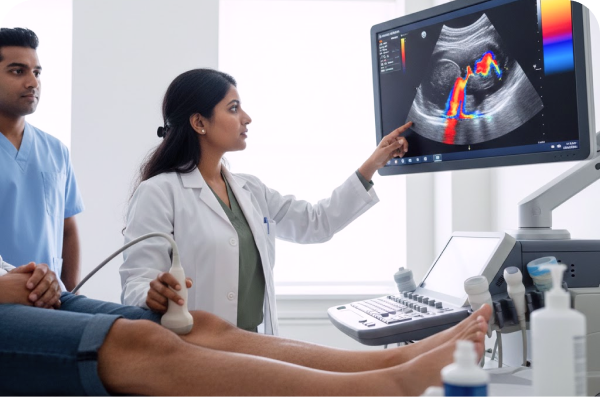
The Colour Doppler Limbs test is a non-invasive, radiation-free ultrasound scan used to assess blood flow in the arteries and veins of the arms and legs. It combines standard ultrasound images with color-coded Doppler signals to show how well blood is moving through your vessels.
This test helps detect blocked arteries, narrowed vessels, blood clots, and problems with vein valves. It is especially useful for people with limb pain, swelling, varicose veins, or suspected deep vein thrombosis (DVT). Because it is painless and safe, it can be performed on patients of all ages, including those with mobility challenges.
Why Is This Test Booked?
You may be advised to undergo a Colour Doppler Limbs test to:
Investigate persistent leg or arm pain, swelling, or discoloration
Check for deep vein thrombosis (DVT) after surgery, long travel, or immobilization
Assess peripheral artery disease (PAD) and look for blocked or narrowed arteries
Evaluate varicose veins, venous insufficiency, or leg ulcers
Monitor stents, grafts, or previous vascular procedures
Determine whether symptoms like claudication, edema, or non-healing wounds are due to arterial or venous issues
Understanding Colour Doppler Limbs (Easy Explanation)
A Colour Doppler Limbs scan uses ultrasound waves to show how blood flows through the vessels in your arms and legs.
Here is how to understand it in simple terms:
What the test does
Creates real-time images of your arteries and veins
Shows blood flow using colors (commonly red and blue)
Helps identify:
Blocked or narrowed arteries
Blood clots in the veins
Poor circulation
Faulty vein valves
Reduced flow due to plaque buildup
How the scan works
A small handheld device (probe) is moved over your skin
It sends sound waves that bounce off moving blood
The machine converts the signals into colors that show:
Direction of blood flow
Speed of blood flow
Any turbulence or flow issues
What parts are checked
The scan usually covers:
Upper limbs: subclavian, axillary, brachial, radial, ulnar arteries and veins
Lower limbs: iliac, femoral, popliteal, tibial, and peroneal arteries and veins
Compression tests may be done to suspect DVT to check whether a vein compresses normally.
Who benefits the most
This test is helpful for individuals with:
Leg cramps or pain during walking
Cold or numb limbs
Tingling or heaviness
Swelling or varicose veins
Sudden limb pain that may indicate a clot
How long does it take?
The procedure generally takes 30-60 minutes, depending on whether one or both limbs are being scanned.
After the scan
You can return to normal activities immediately. Results typically mention blood flow patterns, any narrowing, clot presence, or abnormal waveforms.
What Does the Colour Doppler Limbs Test Measure?
This test evaluates:
Arteries
Whether blood flow is normal, reduced, or blocked
Speed of blood flow (slow flow may indicate narrowing)
Presence of plaque, stenosis, or aneurysm
Whether the flow pattern is triphasic (normal), biphasic, or monophasic (abnormal)
Veins
Vein compressibility (non-compressible veins may indicate a clot)
Direction of blood flow (reverse flow indicates valve leakage)
Whether the flow changes with breathing
Clots, obstructions, or varicose veins
Venous reflux (when valves don't close properly)
Other findings may include:
Pseudoaneurysms
Turbulent flow
Abnormal waveforms
Vascular changes after treatment
Frequently Asked Questions (FAQs )
1. Is the Colour Doppler Limbs test safe? Yes. It uses ultrasound waves, not radiation, and is completely safe for all age groups.
2. How long does the procedure take? Usually 30-60 minutes, depending on the extent of evaluation.
3. Does the Colour Doppler test cause any pain? No. It is painless. You may only feel mild pressure from the probe.
4. Do I need a doctor's referral for this test? Most centers prefer a referral to make the scan more targeted, but some may allow direct booking.
5. How often should this test be repeated? This depends on your condition, ranging from a few months (for DVT monitoring) to yearly (for PAD follow-ups).
6. Which blood vessels are examined? The scan checks all major arteries and veins of both upper and lower limbs.