

 Made with Levo




Understanding the Anti-Müllerian Hormone (AMH) test
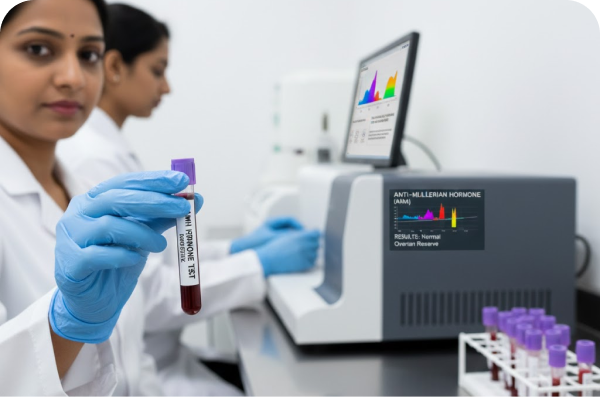
The Anti-Müllerian Hormone (AMH) test is a valuable diagnostic tool that measures the level of AMH in a blood sample. Although all people produce AMH, this test is most frequently used by healthcare providers to assess reproductive health, particularly in individuals with ovaries. The hormone itself plays a significant role in fetal development and, later in life, serves as a crucial indicator of ovarian reserve in females and testicular function in males.
What is Anti-Müllerian Hormone (AMH)?
Anti-Müllerian Hormone is a protein hormone produced by specific reproductive tissues.
In Males, AMH is made by the testicles (or testes). During male fetal development, AMH is essential for the regression of the Müllerian ducts, which would otherwise develop into female reproductive structures. In infant males, AMH levels are measured to check for healthy, working testicles, especially if they haven't dropped into the scrotum, or to aid in the diagnosis of disorders of sexual development.
In Females, AMH is produced by the ovaries. Specifically, it is made by the granulosa cells of small, early-stage follicles—the tiny fluid-filled sacs in the ovary that contain and nurture immature eggs.
The Significance of AMH Levels in Females
For females of childbearing age, AMH levels provide a critical snapshot of ovarian reserve—the quantity of eggs remaining in the ovaries.
AMH levels correlate directly with the number of early-stage follicles:
Higher AMH levels typically mean a larger supply of eggs and a higher ovarian reserve.
Lower AMH levels mean fewer eggs and a lower ovarian reserve.
AMH levels naturally change over a female's lifespan:
Childhood: AMH levels are low in female children.
Puberty/Childbearing Age: Follicles begin to make more AMH. Healthy females of reproductive age will have measurable AMH levels.
Aging and Menopause: As the number of eggs decreases with age, AMH levels decline. At menopause, when no viable eggs are left, AMH levels drop to zero.
It is important to note that while an AMH test indicates the size of the ovarian reserve, it cannot predict the health or quality of the remaining eggs, nor can it definitively predict whether an individual will be able to get pregnant.
Why is an AMH Test Performed?
Healthcare providers utilize the AMH test for various diagnostic and planning purposes, mainly related to reproductive health:
1. Assessing Ovarian Reserve:
The most common use is to help find out if an individual's egg supply is normal for their age. This information can be vital for individuals planning a pregnancy or concerned about their biological clock. AMH levels naturally decline with age, so seeing a lower reserve in one's 30s, 40s, and 50s is expected.
2. Fertility Treatment Planning (IVF):
For those undergoing assisted reproductive technology, like in vitro fertilization (IVF), the AMH test helps determine the optimal treatment plan. Higher AMH levels suggest a person is likely to respond well to fertility medicine (ovarian stimulation drugs) and may only need a small dose. Conversely, low AMH levels may suggest the need for higher doses to elicit a response. The test may also reveal a shorter window of time to achieve pregnancy.
3. Diagnosing Conditions Related to Ovaries:
Polycystic Ovary Syndrome (PCOS): High AMH levels can be a sign of PCOS, a common hormonal disorder. Follicles in people with PCOS often stop developing prematurely, leading to a large number of small, resting follicles that release high amounts of AMH. However, an AMH test alone cannot diagnose PCOS; it is used alongside other clinical and lab data.
Premature/Early Menopause: Low AMH levels may suggest an individual is nearing premature menopause (before age 40) or early menopause (before age 45). However, the test cannot predict the exact timing of menopause, which typically occurs around age 52.
Ovarian Tumors: The test can help diagnose and monitor certain ovarian masses, specifically granulosa cell tumors, as these tumors often secrete AMH. Providers may use AMH levels to check if tumor treatment is working or if the tumor has returned.
4. Pediatric and Other Applications:
Cryptorchidism: In male babies or children whose testicles haven't descended (cryptorchidism), AMH levels can help confirm if healthy, functional testicles are present inside the body.
Disorders of Sexual Development: For babies born with genitals that are not clearly male or female, the AMH test, often combined with other hormone tests, can help diagnose the cause of the disorder and confirm the child's sex.
The Test Procedure
The AMH test is a straightforward blood test. A healthcare professional draws a small sample of blood, usually from a vein in the arm, and sends it to a laboratory for analysis.
Unlike many other reproductive hormone tests, AMH levels do not fluctuate significantly throughout the menstrual cycle. Therefore, the test can be performed at any point in the month without specific timing requirements.
Interpreting the Results
AMH levels are measured in nanograms per milliliter (ng/mL). While experts may debate the exact definition of "typical" levels, general ranges exist:
Average Range: Typically between $1.0\ ng/mL$ to $3.0\ ng/mL$.
Low Range: Generally considered under $1.0\ ng/mL$.
In the context of fertility:
If an individual is healthy and trying to conceive, the provider will explain what the AMH results mean for their fertility based on their age and other comprehensive test results.
Low AMH levels suggest a diminished ovarian reserve, meaning the individual has fewer eggs remaining than average for their age, possibly shortening their window to get pregnant.
Important Considerations:
The AMH test is a valuable tool, but it is not a predictor of pregnancy. Many factors influence the ability to conceive, including age, the health of the eggs, medical conditions, smoking status, and the partner's sperm count and motility. If AMH levels are high, especially with corresponding symptoms, it may indicate conditions like PCOS. Low AMH suggests approaching menopause, but cannot predict the timing.
If a patient receives AMH test results, they should schedule a follow-up appointment with their healthcare provider or a fertility specialist. The specialist can provide a comprehensive assessment and discuss the best pregnancy or treatment plan tailored to the individual's specific circumstances.
Frequently Asked Questions (FAQs)
1. What is an AMH (Anti-Mullerian Hormone) test used for?
The AMH (Anti-Mullerian Hormone) test checks a woman’s ovarian reserve and fertility potential. It helps diagnose conditions like polycystic ovary syndrome (PCOS) and menstrual problems. It is also useful if you are planning a pregnancy, facing fertility issues, or want to assess your reproductive health.
2. How is an AMH (Anti-Mullerian Hormone) test performed?
A healthcare professional will clean your skin with an alcohol swab and take a small blood sample from a vein using a needle. The sample is safely stored and sent to a lab for analysis.
3. Can I take the AMH (Anti-Mullerian Hormone) test during menstruation?
Yes. AMH (Anti-Mullerian Hormone) levels stay fairly constant throughout the month. However, your doctor may suggest testing on days 2 to 4 of your cycle to better assess ovarian reserve.
4. What do high AMH levels indicate?
High AMH levels in women may suggest PCOS or a higher risk of ovarian hyperstimulation during fertility treatments. In men, AMH levels may relate to fertility or infertility concerns.
5. Does low AMH mean early menopause?
AMH correlates with ovarian reserve and can give a rough estimate of menopause timing trends in populations, but it cannot precisely predict the exact age of menopause for an individual.
6. How can I increase my AMH levels naturally?
While AMH cannot be significantly increased, some lifestyle changes may help: Stay physically active, Maintain a healthy weight, Eat a balanced diet rich in proteins, vitamins, and antioxidants, Get good sleep and Manage stress


